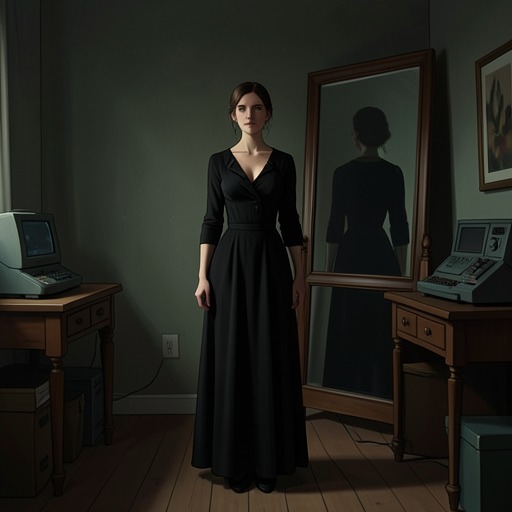
Vampire's love for humans
The Vampire LestatThe love of mortals is presented as both a defining capacity of vampires and a source of anguish. For Lestat, it begins not after centuries of experience but in his earliest nights, inseparable from the intimacy and violence of feeding. The old queen disputes his certainty: love, she says, is an understanding acquired over time, and one that may eventually make a vampire unable to kill without pain. Their disagreement turns love from a simple virtue into a conflict between attachment to human life and the vampire’s dependence on taking it.
Love and the Vampire Condition
The old queen describes a vampire who leaves a coven to live among human beings as facing a particular torment. Such a vampire, she argues, comes irresistibly to love mortals and, through that love, to understand them in ways they may never understand one another. With time, this knowledge can become unbearable: the vampire may no longer endure taking life or causing suffering, while madness or death appears to offer the only relief. Love is therefore not merely affection in her account; it is an expanding recognition of what vampire survival costs others.
The rules of the Children of Darkness give this conflict a social and religious form. Their doctrine directs vampires to live among the dead, return to graves, avoid places of light, and lure victims away from human company. It also commands reverence for God and forbids entry into the House of God. Against this discipline, love of mortals pulls a vampire toward human lives and the consequences of feeding on them. The old queen’s account suggests that isolation from human society is intended to forestall a painful attachment, even as Lestat’s experience challenges the premise that such attachment can be avoided.
Lestat’s Rebuttal
Lestat rejects the old queen’s suggestion that love arrives only after a long apprenticeship in immortality. He insists that from the first nights when he held mortals close, he loved them, even as he drank their life. He treats this contradiction not as evidence against love but as the essence of the Dark Gift: the vampire’s relation to mortals contains tenderness and fatal dependence at once. His challenge is directed at the idea that mere longevity grants a superior understanding of love. In his view, a vampire’s capacity to love does not have to wait three hundred years to emerge.
The dispute becomes a confrontation over what vampirism does to moral feeling. Lestat calls the notion that love is a weakness or a late lesson a simplification, and asks whether a vampire can fail to love mortals. The old queen answers that he feels pity—for them and for himself, because he cannot be both human and inhuman—and that he has only begun to love. Her prediction is that immortality will deepen understanding even when the vampire becomes cruel or hateful. The two accounts remain unresolved: Lestat emphasizes love as immediate and constitutive, while the queen describes it as knowledge that grows through time and suffering.
Mortality, Memory, and the Cost of Attachment
Lestat’s defense is rooted in his experience of closeness to mortals, but it does not erase the difference between loving a human and making that human a vampire. In a later confrontation, Armand turns the question back on him: Lestat’s love of mortals must be considered alongside what he has already done to them. Armand argues that the transformation from mortal life to vampire existence can ravage the person’s spirit. Its outcomes vary: a fledgling may resent the one who took their life, pursue excesses the maker disapproves of, emerge mentally disturbed, become uncontrollable, grow jealous of the maker’s power, or shut the maker out.
Armand’s conclusion is that a veil will always fall between maker and fledgling. Even if a vampire creates a legion, Armand says, the maker will remain alone. This warning complicates Lestat’s claim that love is intrinsic to the Dark Gift: love may motivate intimacy, yet the act through which a vampire tries to preserve or transform a mortal can produce estrangement rather than lasting closeness. The evidence does not make love a remedy for that divide. Instead, attachment heightens the stakes of vampiric creation because the vampire must confront the possibility that the beloved will be changed, alienated, or lost to them.
Narrative Significance
The concept is developed through competing testimony rather than a single settled doctrine. The old queen speaks from the perspective of accumulated time and foretells love’s painful consequences; Lestat answers from an intimate conviction that love was present from the beginning; Armand later stresses the relational damage that may follow when a mortal is made immortal. Together, their claims separate three questions that vampire doctrine can blur: whether vampires can love humans, whether love deepens with experience, and whether love can overcome the consequences of transforming a human being.
That tension gives love a double role in the story. It is a bond to mortal life and a challenge to rules designed to keep vampires among the dead, away from ordinary human community. Yet it cannot undo the vampire’s dependence on human blood or guarantee mutual understanding after transformation. The concept consequently offers no easy reconciliation between tenderness and harm: the capacity to love mortals may be real, but it also makes the vampire’s separation from them more painful and more visible.